The MEC group developed the Yeast Pathway Kit (YPK) protocol for the in-vivo assembly of multiple genes. This protocol was published (Pereira et. al 2015).
The protocol offers reusable promoters, genes and terminators.
Quick links:
- Primer design for genes to be cloned in pYPKa (often necessary to express a new gene using the Yeast Pathway Kit)
- Example of in-silico assembly of a pYPKa vector for the expression of a gene
- Example of how to assemble a Transcriptional Unit (TU) vector in-silico
- Available Plasmid, Promoter & Terminator sequence files
- How to clone a DNA fragment using the pYPKa vector in the wet lab
- How to assemble a single gene yeast expression vector (TU vector) in the wet lab
We use this protocol for the generation of expression cassettes (TU, transcriptional units) as well as large metabolic pathways that are yet relatively compact compared to pathways assembled with other protocols in Saccharomyces cerevisiae. YPK relies on natural intergenic sequences which might be positive for genetic stability.
The genetic building block DNA fragments (promoters, genes and terminators) are all cloned in an E. coli positive selection vector called pYPKa.
The fragments are cloned one at a time, creating one plasmid per fragment.
These plasmids are used as template for PCR amplification and joined together by homologous recombination into single gene expression vectors (Transcriptional Units, TU) using a S. cerevisiae/E. coli shuttle vector such as the pTAx series or pYPKpw (sequences here).
These TU vectors can be further assembled into large (at least 13 genes has been successfully assembled) metabolic pathways by homologous recombination between promoters and terminators of the transcriptional units.
Cloning of Genetic Building Blocks in pYPKa
The pYPKa vector is a derivative of the positive selection vector pCAPs. This vector is very efficient and permits direct cloning of PCR products directly from the PCR mix without removal of the DNA polymerase, primers or nucleotides.
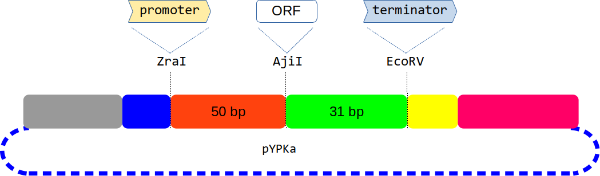
Promoters, genes and terminators are cloned in one of three unique blunt restriction sites in pYPKa (Table#1).
| Table#1 | Element | Cloning site | Name | Alternative enzymes |
|---|---|---|---|---|
| Promoters | ZraI | pYPKa_Z_ABC1 | - | |
| Gene (orf) | AjiI | pYPKa_A_ABC1 | BtrI BmgBI | |
| Terminator | EcoRV | pYPKa_E_ABC1 | Eco32I |
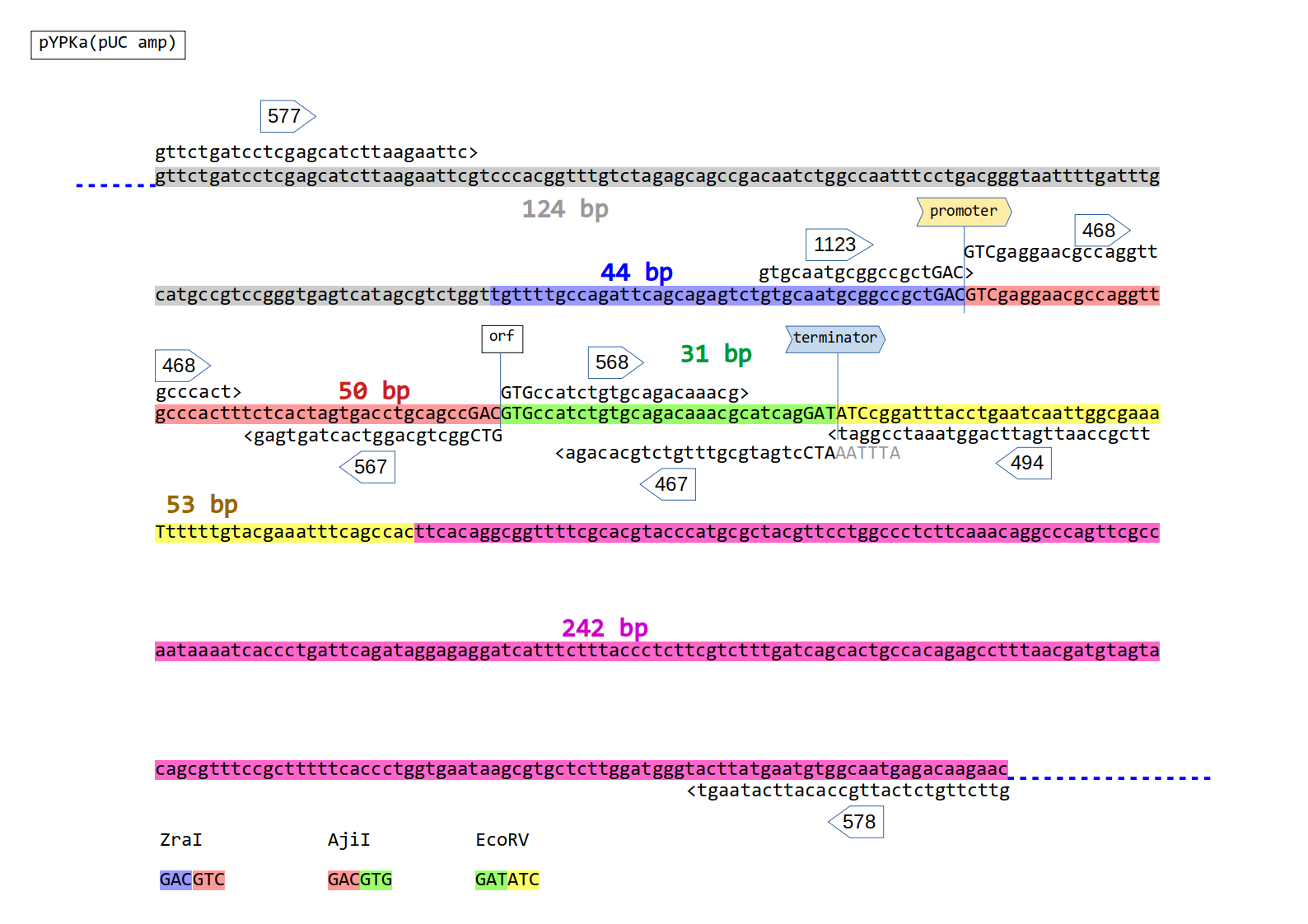
These sites are located close together in pYPKa in the order given in Table#1. The figure below shows the ZraI and AjiI cut sites separated by 50 bp (red in the figure below) and AjiI and EcoRV separated by 31 bp (green).
Note
Only one DNA fragment (a promoter, gene or a terminator) is cloned in each pYPKa plasmid.
Naming convention for pYPKa vectors
The resulting plasmids are named using a systematic nomenclature. A pYPKa plasmid carrying the ABC1 fragment cloned in the ZraI site is named pYPKa_Z_ABC1. Optionally, a short prefix can be added indicating the strain or organism from which the gene was sourced.
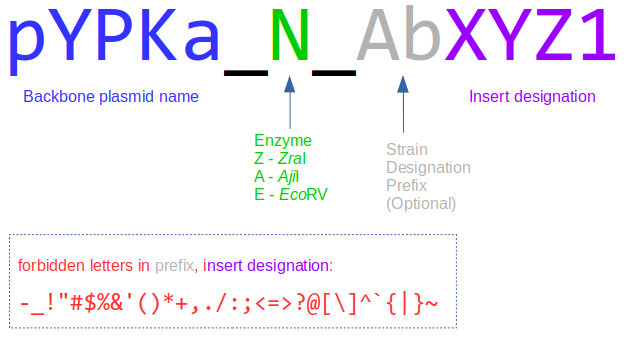
We use the following prefixes: Sc for Saccharomyces cerevisiae, Ec for Escherichia coli and Yl for Yarrowia Lipolytica and At for Arabidopsis thaliana. For other cases, consider using the KEGG three letter abbreviation.
Note
The plasmid name should also function as a file name, so only use ASCII letters (a -z A -Z 0-9). Avoid these characters: ! ” # $ % & ’ ( ) * + , - . / : ; < = > ? @ [ \ ] ^ _ ` { | } ~
Promoters and terminators in pYPKa_Z and pYPKa_E vectors can be reused. This repository has over sixty S. cerevisiae intergenic sequences cloned in pYPKa.
Primer design
Certain conventions should be followed for primer design for genes to be cloned in the pYPKa for gene expression, i.e. creating a new pYPKa_A_ABC1 vector.
In-silico assembly
It is a good practice to create a new cloning project in-silico prior to starting the lab work. This example is provided for how to use the DNA editor ApE in combination with PydnaWeb to manually assemble a pYPKa clone in-silico.
Wet-lab protocol
Look at the pYPKa cloning protocol for how to clone a PCR product using pYPKa in the lab.
Assembly of Single Gene Transcription Unit (TU) vectors
The purpose of the pYPKa_* vectors described in the previous section is to provide building blocks for TUs (Transcriptional Units), each expressing one gene. A single gene is cloned between a promoter and a terminator by in-vivo homologous recombination between three PCR products obtained from pYPKa_* vectors and a linearized S. cerevisiae/E. coli shuttle vector.
Since all fragment are cloned in the same vector, DNA fragments sharing terminal homology are easily produced by choosing the right PCR primers.
Approximate location of six PCR primers used for this purpose are indicated by numbers in the figure below (577, 567), (468, 467) and (568, 578).
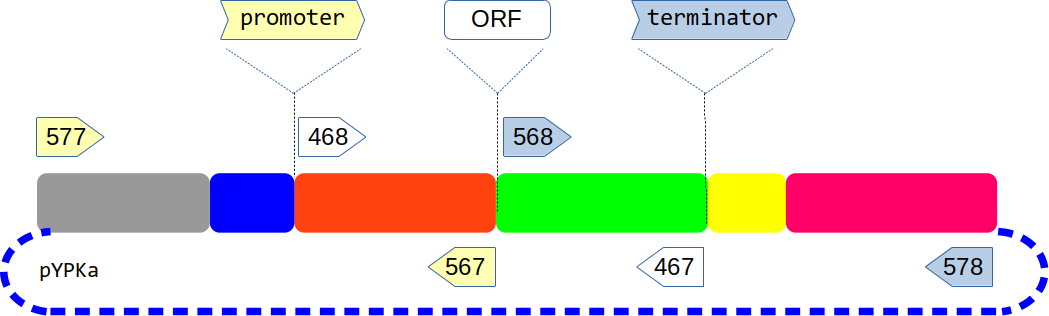
Promoters are amplified using primers 577+567, genes using 468+467 and terminators using 568+578.
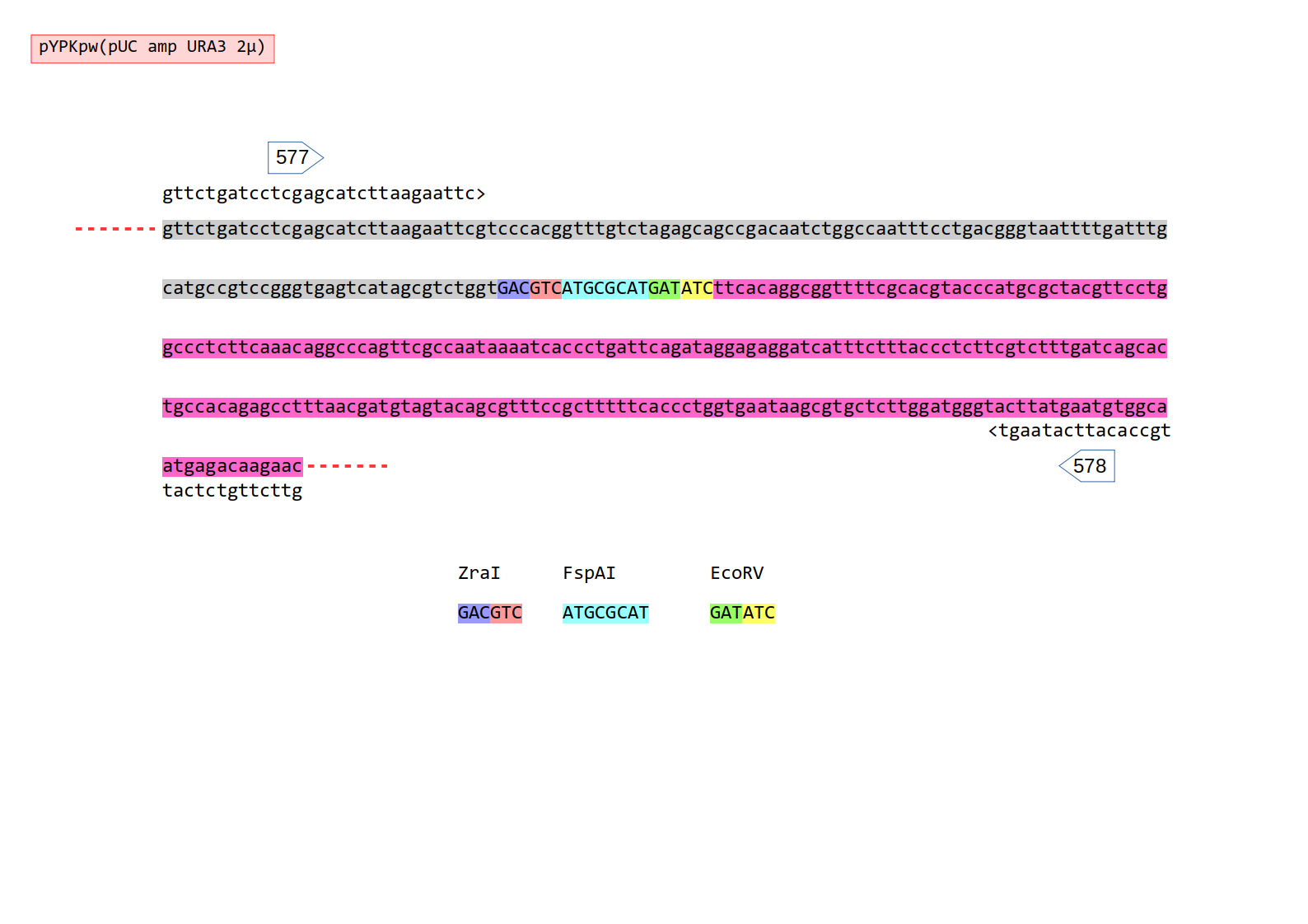
The three PCR products are mixed with a linearized shuttle vector (pYPKpw or similar). The linear vector is the red dashed line in the figure below.The vector carries regions of homology to the promoter and terminator PCR products, gray and pink boxes respectively.
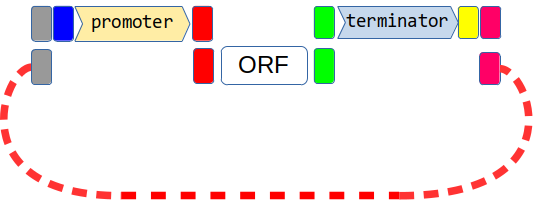
See the specific protocol for how to construct a TU vector in the lab. A combination of web services, the software package pydna and and Google colab can be used to rapidly assemble the sequence (see here).
Naming convention

Assembly of Multiple Gene Expression Constructs
Metabolic pathways can later be built by linking single gene expression cassettes together in a second assembly step. This assembly has to be carefully planned already before the construction of the TU vectors. Transcriptional units are joined by recombination between mutually shared promoter and terminator sequences.
For this to be possible, promoters and terminators need to be identical DNA fragments in adjacent transcriptional units.
Summaries and cheat sheets for the Yeast Pathway Kit
Primer locations around the ZraI, AjiI and EcoRV sites in pYPKa:
Primer locations around the ZraI, AjiI and EcoRV sites in pYPKpw and derived vectors, such as the pTAx series:
A short summary of the Yeast Pathway Kit:
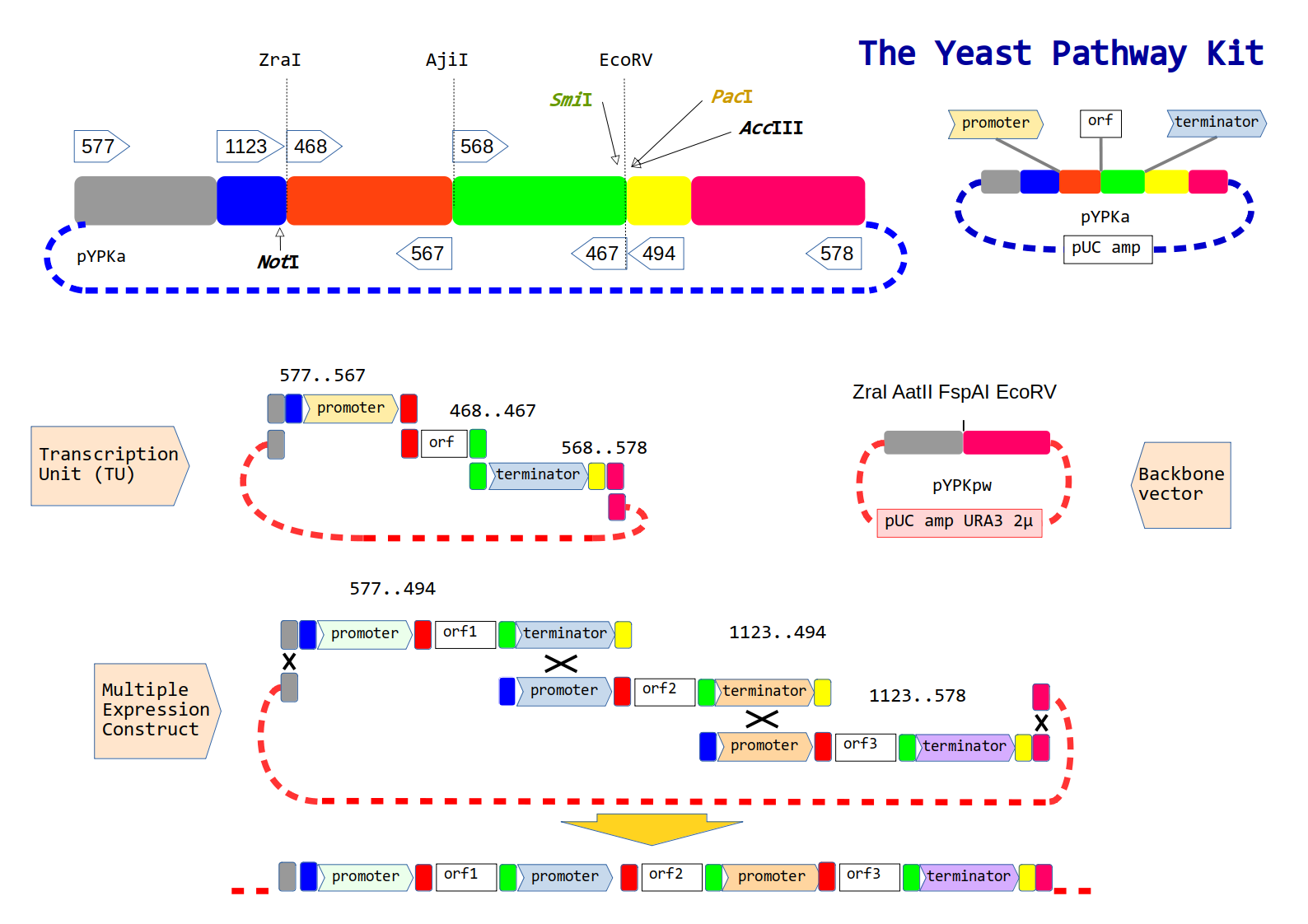
A PDF version: A3_YPK_poster.pdf
Paper version taped to the fridge in the lab:
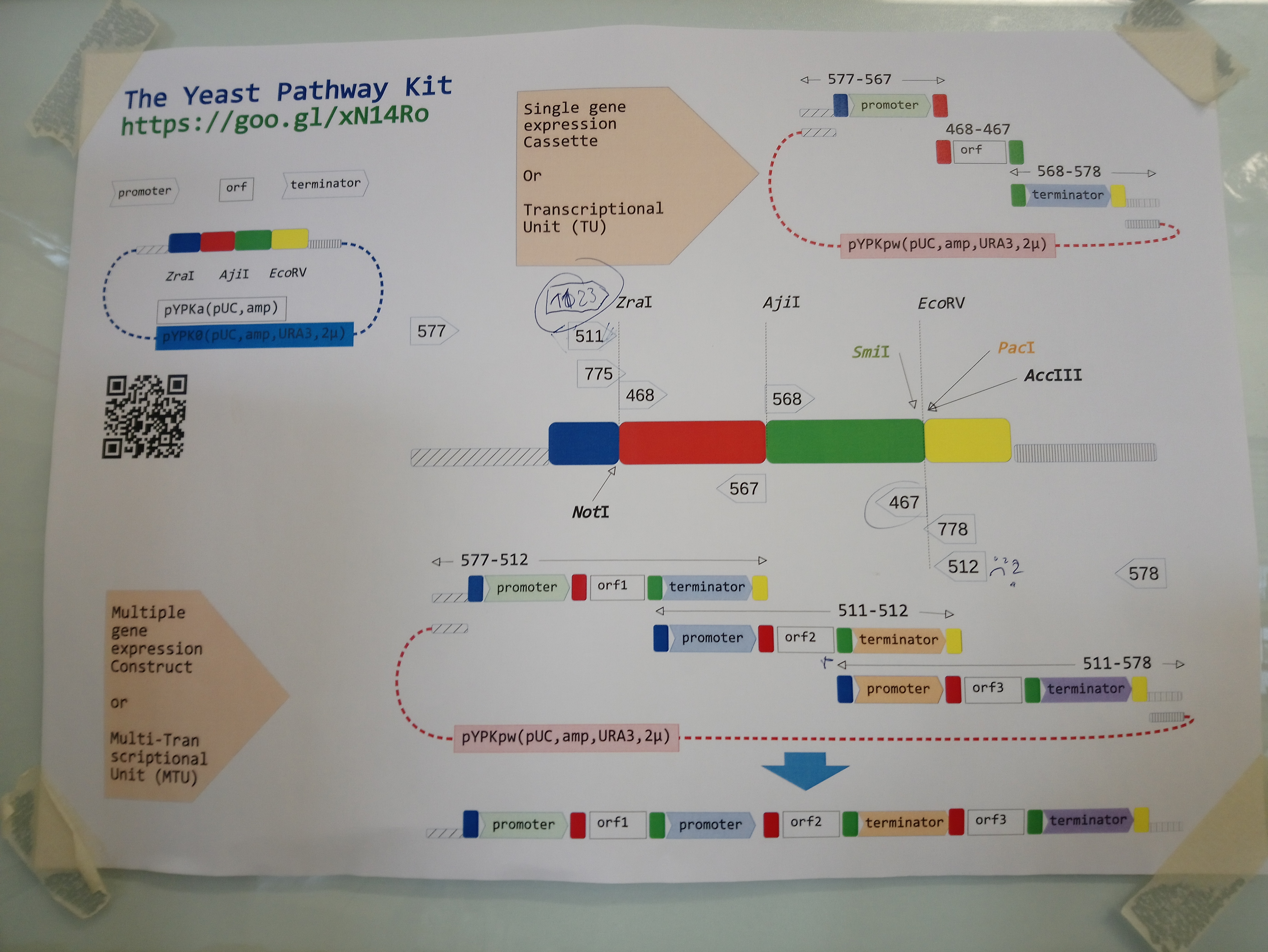
Some alternative primers:
                             >-gene-->
            >-TP-->           \     /           >-TP-->
             \   /             \   /             \   /
     517>     \ /               \ /               \ /
 p577>    1123>|p468>       <p567|p568>       <p467|<494        <p578       < recommended
               |                 |                 |
               |                 |                 |
               |                 |                 |
               |                 |                 |
           775>|                 |                 |<778
  167>    <511 |<776             |             777>|    <512     <166
               |                 |                 |               <342
               |                 |                 |
 ✽✽gray✽blue✽N-Z======red========A++++++green+++++E-A••yellow••pink••••••
|            o r                 j                 c c                   |
|            t a                 i                 o c                   |
|            I I                 I                 R I                   |
|                               (*)                V I                   |
|                                                    I                   |
GRAY-BLUE-RED-GREEN-YELLOW-PINK
>GRAY 124 bp GC 50% This sequence is present in pYPKpw 577 -
gttctgatcctcgagcatcttaagaattcgtcccacggtttgtctagagcagccgacaatctggccaatttcctgacgggtaattttgatttgcatgccgtccgggtgagtcatagcgtctgg

>BLUE 44 bp GC 55%   ? - 511
tgttttgccagattcagcagagtctgtgcaatgcggccgctGAC

>RED 50 bp GC 60% 468 567
GTCgaggaacgccaggttgcccactttctcactagtgacctgcagccGAC

>GREEN 31 bp GC 52% 568 467
GTGccatctgtgcagacaaacgcatcagGAT

>YELLOW 53 bp GC 36% 500 - (166? 1219? too long)
ATCcggatttacctgaatcaattggcgaaattttttgtacgaaatttcagcca

>PINK 242 bp GC 48% This sequence is present in pYPKpw     ?  - 578
cttcacaggcggttttcgcacgtacccatgcgctacgttcctggccctcttcaaacaggcccagttcgccaataaaatcaccctgattcagataggagaggatcatttctttaccctcttcgtctttgatcagcactgccacagagcctttaacgatgtagtacagcgtttccgctttttcaccctggtgaataagcgtgctcttggatgggtacttatgaatgtggcaatgagacaagaac
GFP fusion
*promoter=
         =genetxt+
                 +terminator•

*promoter=
         =gene~
              ~gfp+
                  +terminator•

*promoter=
         =mcs~
             ~gfp+
                 +CYC1t•
~ = linkers (35 bp)