
The objective of this lab course is to construct a new plasmid cloning vector in the pTAx series. This vector will be an E. coli / Saccharomyces cerevisiae shuttle vector. This vector will be useful for cloning genes and pathways using the Yeast Pathway Kit, see the next section “Background” “for more details.
Background
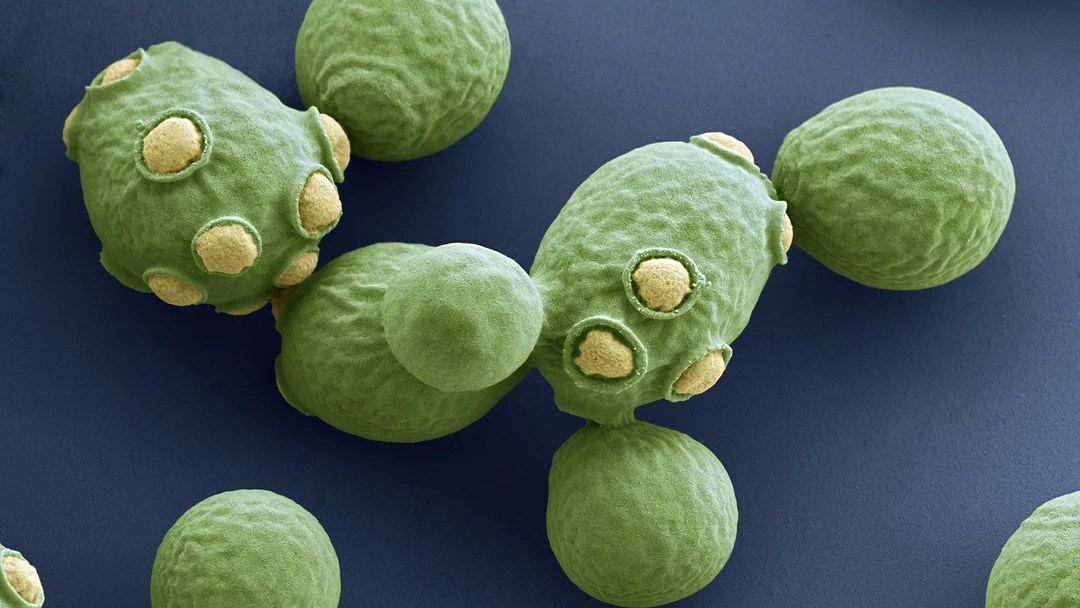
In the mec research group, we are interested in understanding and engineering the biosynthesis of fatty acids and related products by the unicellular fungi known as baker’s yeast S. cerevisiae.
Genetic engineering of complex traits often require the simultaneous deletion and/or expression of multiple genes. This is a challenging problem as genetic engineering is time consuming. To solve this problem, we developed a protocol for the parallel assembly of metabolic pathways that we call the Yeast Pathway Kit (YPK). See our publication in ACS Synthetic Biology for more details.
We use this protocol for rapid construction and expression of large metabolic pathways in baker’s yeast Saccharomyces cerevisiae such as the pTA1_FASIIb metabolic pathway expressing twelve genes from E. coli and A. thaliana link heterologous fatty acid synthesis pathway.
Plasmids in the pTAx series are used to propagate these constructs in E. coli or S. cerevisiae.
The underlying problem we would like to solve
In order to replicate in both E.coli and S. cerevisiae, a plasmid needs at least:
- a selection marker for E. coli
- a selection marker for S. cerevisiae.
- an origin of replication for E. coli
- an origin of replication for S. cerevisiae.
The first plasmid we used to express large pathways was called pYPKpw and it has the five functional parts indicated in Table#1:
| Table#1, pYPKpw | part | function |
|---|---|---|
| ampR | selection marker for E. coli. | |
| pUC | origin of replication for E. coli. | |
| 2µ | multicopy origin of replication for S. cerevisiae from the natural 2µ plasmid | |
| URA3 | selection marker for for S. cerevisiae. | |
| Δcrp | a partial, inactive E. coli cyclic AMP receptor protein or CRP gene. |
The last element in the table, Δcrp is an E. coli gene which is inactive and only provide a recombination site. The pathways that we make are meant for S. cerevisiae, but we often need to transfer the pathway to E. coli so we can obtain larger amounts of higher quality DNA for analysis or transformation.
The pUC origin of replication (ORI) results in a high copy number of the vector in E. coli which is an advantage for obtaining large amounts of DNA. However, we have observed genetic instability in E. coli for some large pathways that we suspect is linked to high copy number. Our experience is that a lower copy number provides more stability.
pTAx vectors with increased stability
We conceived a series of plasmid vectors called pTAx where x is a number from pTA1..11 (at the moment). The pTAx vectors were designed to have a relatively low copy number in E. coli to try to solve the stability problems of pYPKpw.
The copy number in E. coli should be lower since they have the intact pBR origin of replication (from plasmid pBR322) that includes the ROP gene, while the pYPKpw has the high-copy pUC origin of replication from the pUC19 plasmid.
pTA1 was the first pTAx plasmid constructed by a former post-doc in the group, Tatiana Andrevna Pozdniakova, hence the name.
The pTAx vectors are made from five genetic elements using in-vivo homologous recombination between five PCR products (Table #2 ➀, ➁, ➂, ➃ and ➄).
See pTAx assembly strategy for details of how the five PCR products are assembled into a plasmid..
The pTAx vectors are similar to each other, but differ in the selection markers (yeast marker) and yeast origin of replication (yeast ORI).
| Table#2 | Name | E. coli marker | E. coli ORI | yeast ORI | yeast marker | MCS | Constructed by: | Enzyme to linearize | 🥶 freezer list number(s) | Sequenced? | Date |
|---|---|---|---|---|---|---|---|---|---|---|---|
| ➀ | ➁ | ➂ | ➃ | ➄ | |||||||
| pTA1 | ampR | pBR | 2µ | LEU2 | Δcrp | Tatiana Pozdniakova | AatII, ZraI, FspAI | µ828, µ928, µ929 | ✅ | 2019-10-xx | |
| pTA2 | -”- | -“- | CEN/ARS | LEU2 | -”- | EGB2023 | AatII, ZraI, FspAI | µ1814, µ1815, µ1817 | 2023-06-01 | ||
| pTA3 | -”- | -“- | 2µ | HIS3 | -”- | Tatiana Pozdniakova | AatII, ZraI, FspAI, EcoRV | µ1271 | 2021-07-09 | ||
| pTA4 | -”- | -“- | CEN/ARS | HIS3 | -”- | EGB2023 | AatII, ZraI, FspAI, EcoRV | µ1816, µ1818, µ1819 | 2023-06-01 | ||
| pTA5 | -”- | -“- | 2µ | KanMX4 | -”- | Paulo Silva, Julio Freire | AatII, ZraI, FspAI, EcoRV | µ1652 | ✅ | 2022-10-11 | |
| pTA6 | -”- | -“- | CEN/ARS | KanMX4 | -”- | GMB20 | AatII, ZraI, FspAI, EcoRV | µ520 | 2020-12-23 | ||
| 🔥 | pTA7 | -”- | -“- | 2µ | TRP1 | -”- | EGB2025 | AatII, ZraI, FspAI | µ20 | ✅ | 2026-04-23 |
| pTA8 | -”- | -“- | CEN/ARS | TRP1 | -”- | GMB20 | AatII, ZraI, FspAI | µ521, µ522 | 2020-12-23 | ||
| pTA9 | -”- | -“- | 2µ | URA3 | -”- | Tatiana Pozdniakova | AatII, ZraI, FspAI | µ1272 | 2021-07-09 | ||
| pTA10 | -”- | -“- | CEN/ARS | URA3 | -”- | GMB20 | AatII, ZraI, FspAI | µ523 | 2020-12-23 | ||
| pTA11 | -”- | -“- | 2µ | LEU2d | -”- | EGB2024 | AatII, ZraI, FspAI | µ542 | ✅ | 2024-05-23 |
This lab course is divided into nine practical classes, see below. Each student attends three of the nine classes. In each practical class, we advance the project towards the finished plasmid.
| link | Content | |||
|---|---|---|---|---|
| LAB1 | PL1 | Prepare plasmid DNA from E. coli by small scale alkaline lysis (miniprep). | ||
| LAB2 | PL2 | Agarose gel I (Plasmid DNA ). PCR reactions. | ||
| LAB3 | PL3 | Agarose gel II (PCR products), Inoculate S. cerevisiae culture. | ||
| LAB4 | PL1 | Yeast (S. cerevisiae) transformation. | ||
| LAB5 | PL2 | In-silico assembly of plasmid 💻 | ||
| LAB6 | PL3 | Yeast colony PCR | ||
| LAB7 | PL1 | Agarose gel III (colony PCR), Yeast culture Inoculation of plasmid candidates | ||
| LAB8 | PL2 | Plasmid rescue to E. coli | ||
| LAB9 | PL3 | Plasmid rescue to E. coli (II) | ||
| LAB10 | (Opt) | (Opt) | (Opt) | Analytical restriction digestion of plasmid DNA. Prepare DNA for sequencing. |