ColE1/pMB1 replication control (RNAII vs RNAI)
Both pBR322 and pUC-class plasmids use the same basic mechanism to replicate:
-
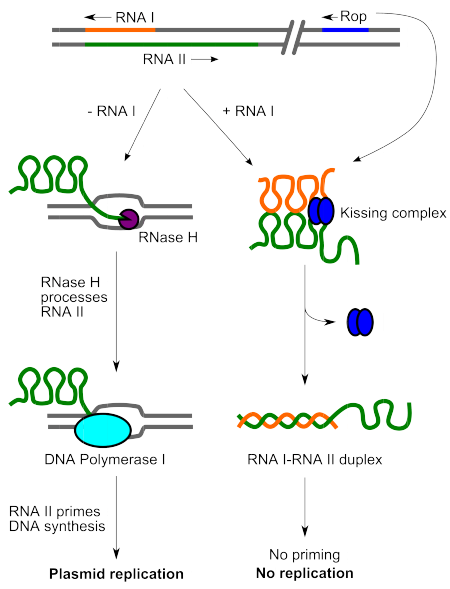
RNAII is transcribed through the origin region and forms an RNA–DNA hybrid (an R-loop) near the ori. After processing, it serves as the primer to start DNA synthesis.
-
RNAI is a short antisense RNA that base-pairs with the nascent RNAII transcript and prevents RNAII from forming the correct structure needed to become a primer — so replication is inhibited.
-
Therefore, copy number is set by the balance between productive RNAII priming and RNAI-mediated inhibition. See figure below:
pBR322 origin: lower/moderate copy with stronger negative control (Rop present)
-
Rop is a small plasmid-encoded protein that stabilizes the interaction between RNAI and RNAII (it helps the RNAs form the inhibitory complex more efficiently).
-
That makes the inhibition step more reliable → fewer RNAII transcripts successfully mature into primers → lower copy number and typically better stability/less burden than very high-copy plasmids.
pUC origin: high copy because key “brakes” were removed/disabled (rop deleted + RNAII mutation)
The pUC series (pUC18/19, etc.) were engineered for cloning convenience and very high yields of plasmid DNA. They achieve that high copy number mainly through two changes compared with pBR322-type replicons:
(A) Deletion of rop
pUC plasmids lack the rop gene, removing the protein that boosts RNAI–RNAII inhibitory complex formation. That weakens negative regulation and pushes copy number upward.
(B) A point mutation in RNAII
The pUC high-copy is also driven by a single point mutation in the RNAII primer region, which alters how well RNAI can inhibit RNAII.
4) Practical consequences
Copy number and DNA yield
-
pBR322-type ori (with rop): typically “moderate/low-ish” copy, steadier.
-
pUC-type ori: can be much higher copy, often dramatically increasing miniprep yield. Addgene summarizes this difference as arising from only a small number of mutations with very large copy-number effects. (blog.addgene.org)