Antibiotics
2026-06-03
Final concentrations generally recommended.
- 100 µg/mL Ampicillin (E. coli)
- 12.5 µg/mL Tetracycline (E. coli)
- 50 µg/ml Kanamycin (E. coli)
- 100 µg/mL G418 (S. cerevisiae)
- 250 µg/mL Hygromycin B (S. cerevisiae)
- 100 μg/ml clonNAT (S. cerevisiae)
- 34 µg/ml Chloramphenicol (E. coli for selection)
IMPORTANT
Note the difference between mg and µg. 1 mg = 1000 µg
Ampicillin stock solution (100 mg/ml = 1000 X concentrated)
How to prepare Protocol for ampicillin 100 mg/ml stock solution stock (x 1000).
- Weigh ~1 g ampicillin sodium sulfate powder (Fisher 1760-25) in a Falcon 50 mL tube.
- Add water to the 10 mL mark and vortex. Adjust the volume with water if necessary.
- Filter through 0.22 µm membrane with a new syringe.
- Store at -20 in 1 ml aliquots.
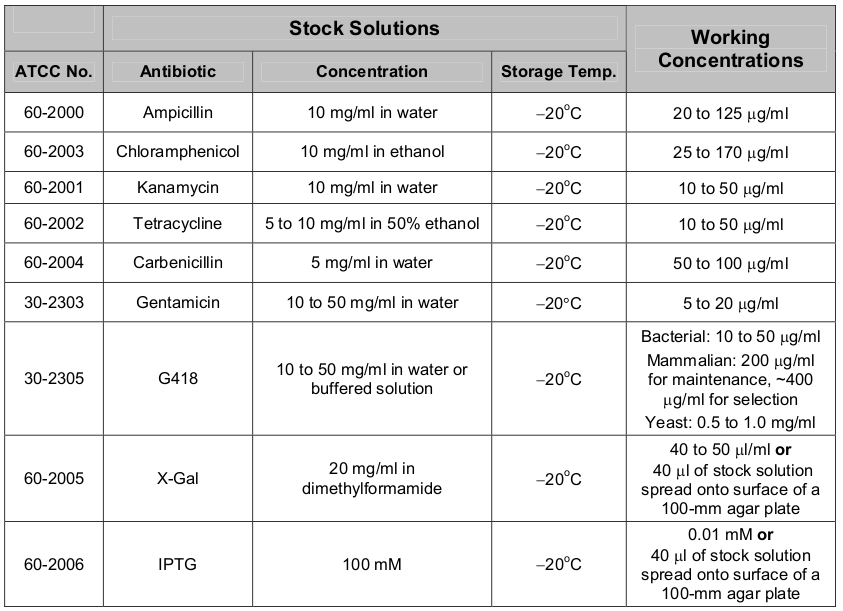
Final concentration for E. coli should be 100 µg/ml. This is close to the upper
limit recommended by ATCC (see below). The stock solution is stored in 1 mL
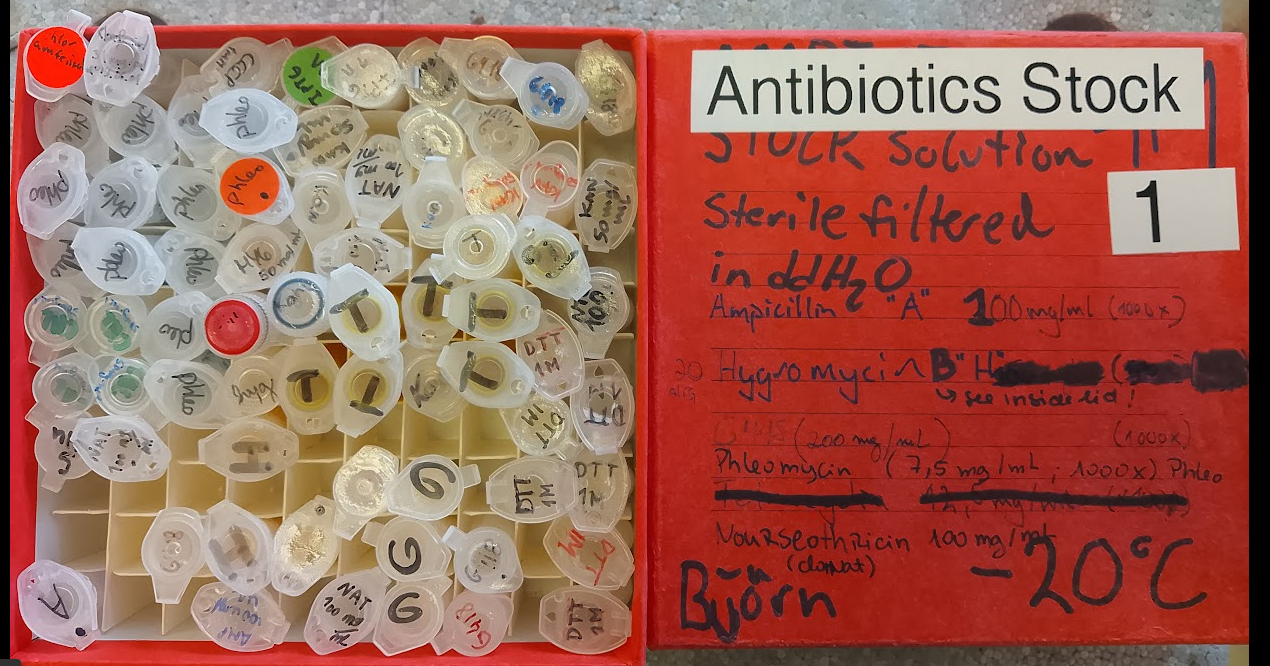
aliquots marked with a capital “A” at -20°C in the box marked “Antibiotics” in the -20 freezer.
Kanamycin stock solution (50 mg/ml = 1000 X concentrated)
- Weigh ~1 g 1 gram of Kanamycin sulfate in a Falcon 50 mL tube.
- Add water to the 20 mL mark and vortex. Adjust the volume with water if necessary.
- Filter through 0.22 µm membrane with a new syringe.
- Store at -20 in 1 ml aliquots.
Final concentration for E. coli should be 50 µg/ml. This is the upper
limit recommended by ATCC (see below).The stock solution is stored in 1 mL
aliquots marked with a capital “K” at -20°C in the box marked “Antibiotics” in the -20 freezer.
Geneticin (G418) stock solution (200 mg/ml = 1000 X concentrated)
Geneticin (Gibco’s brand name) or G418 (generic name) is used to select for yeast that have the KanMX resistance marker.
- Weigh ~2g G418 powder in a Falcon 50 mL tube.
- Add water to the 10 mL mark and vortex. Adjust the volume with water if necessary.
- Filter through 0.22 µm membrane with a new syringe.
- Store at -20 in 1 ml aliquots.
Final concentration for E. coli should be 200 µg/ml. This is less than half of the lower limit concentration recommended by
ATCC (see below). The concentration was recommended by Goldstein & McCusker 1999
The stock solution is stored in 1 mL aliquots marked with a capital “G” at -20°C in the box marked “Antibiotics” in the -20 freezer.
Tetracycline stock solution (100 mg/ml = 8000 X concentrated)
- Add 1.25 g Tetracycline Hydrochloride (MW = 480.898 g/mol) powder to a 15 mL FALCON tube.
- Add 7 mL of Ethanol 99.5% or 96%.
- Add water to 10 mL.
- Mix vigorously and make sure the powder is completely dissolved.
- Aliquot 1 mL per tube and store at -20°C.
It is not necessary to sterile filter this solution since it is made in 70% Ethanol. For E. coli XL1-Blue, use 12.5 µg/mL Tetracycline. The stock solution is stored in 1 mL aliquots marked with a capital “T” at -20°C in the box marked “Antibiotics” in the -20 freezer.
Hygromycin B stock solution (250 mg/ml = 1000 X concentrated)
Standard concentration for selection in S. cerevisiae is 300 µg/ml, we use 250 µg/ml. Stock solution is 250 mg/mL (x 1000):
- Weigh 2.5 g Hygromycin B powder in a Falcon 15 mL tube.
- Add water to the 10 mL mark and vortex. Add more water if necessary.
- Filter through 0.22 µM membrane with a new syringe.
- Store at -20 in 1 ml aliquots.
The 300 µg/ml selection concentration was recommended by Goldstein & McCusker 1999. The stock solution is stored in ~1 mL aliquots marked with a capital “H” at -20°C in the box marked “Antibiotics” in the -20 freezer.
IMPORTANT
Hygromycin might be necessary in larger concentrations than stated here as there might be strain variability.
Nourseothricin (clonNAT) stock solution (100 mg/ml = 1000 X concentrated)
Nourseothricin is a mixture of Streptothricins C, D, E and F and can be used as selection antibiotic for a broad spectrum of pro- and
eukaryotic organisms (i.e. Gram-positive and Gram-negative bacteria, yeast, filamentous fungi, protozoa, micro algae, plants and more.
- Weigh 1 g clonNAT powder in a Falcon 15 mL tube.
- Add water to the 10 mL mark and vortex. Add more water if necessary.
- Filter through 0.22 µM membrane with a new syringe.
- Store at -20 in 1 ml aliquots.
The concentration was recommended by Goldstein & McCusker 1999 The stock solution is stored in 1 mL aliquots marked with a capital “N” at -20°C in the box marked “Antibiotics” in the -20 freezer.
Werner Bioagents recommended:
| Organism | conc (µg/mL) |
|---|---|
| Escherichia coli | 50 |
| Saccharomyces cerevisiae | 100 |
| Ustilago maydis | 75 |
| Leishmania sp. | >100 |
| Cryptococcus neoformans | 100 |
| Arabidopsis thaliana | 100 |
Chloramphenicol stock solution (34 mg/ml = 1000 X concentrated)
To make a 34 mg/mL chloramphenicol stock solution you must dissolve chloramphenicol powder in 100% or 95% ethanol, as it is poorly soluble in water.
| Component | Amount |
|---|---|
| Chloramphenicol Powder | 340 mg |
| Ethanol (100% or 95%) | 10 mL |
- Weigh 340 mg of chloramphenicol powder using an analytical balance and transfer it into a sterile 15 mL conical tube (such as a Falcon tube).
- Add the solvent: Measure 9 mL of 100% ethanol and add it to the tube first.
- Dissolve completely: Cap the tube tightly and vortex or invert it vigorously until the powder is fully dissolved and the liquid is completely clear.
- Bring to volume: Top off the liquid level to exactly the 10 mL mark with ethanol.
- Divide the solution into 1 mL aliquots in sterile microcentrifuge tubes. Label and store at -20°C.
There is no need to filter sterilize this solution. Because it is made in high-concentration ethanol, the solution is sterile.
Standard Usage (1000X Concentration)
When adding this to growth media (like LB broth or LB agar), use a 1:1000 dilution. For example, add 1 mL of stock solution to 1 L of cooled media, resulting in a final working concentration of 34 µg/mL. Always let agar cool to approximately 50°C–55°C before adding the antibiotic to prevent heat degradation. [1, 10, 11, 12]
If you would like, please let me know:
- What total volume of solution you want to prepare?
- Are you using this for bacterial selection or another specific workflow?
I can help calculate exact measurements or provide guidance on preparing the final growth media.
[1] https://www.cytographica.com
[2] https://www.laboratorynotes.com
[4] https://harmslab.uoregon.edu
[8] https://gallowaylabmit.github.io
[10] https://utminers.utep.edu
[11] https://www.benchchem.com
[12] https://antibodies.cancer.gov
ATCC recommendations